When embarking on a luxury bedroom fit-out in Bali, property owners usually focus on raw materials first. Clients frequently request Grade-A Indonesian Teak veneer, rich American Walnut, or imported hardware, assuming expensive materials guarantee luxury. However, two wardrobes built from identical raw timber can deliver completely different visual results. One piece looks mass-produced, while the other feels architecturally integrated and effortlessly luxurious.
The true difference rarely lies in raw material expenses. Instead, true quality depends on micro-joinery details, spatial proportions, and precision craftsmanship. When you invest in a custom wardrobe bali suite, pairing climate-resilient substrates with meticulous execution transforms utility storage into an enduring architectural focal point.
Why Raw Material Alone Does Not Guarantee Luxury
In custom cabinetry manufacturing, premium materials represent only the raw canvas. Without precise spatial alignment, uniform reveal gaps, and intelligent lighting, high-grade veneers lose their visual impact.
For example, crooked door margins or dark, unlit interiors look unrefined regardless of timber costs. Conversely, a cabinet constructed from High Moisture Resistance (HMR) board—when executed with surgical machining tolerances, continuous grain flow, and hidden profiles—delivers a sleek, hotel-grade aesthetic. Luxury joinery depends on optical harmony: eliminating visual noise and aligning architectural sightlines.
1. The Shadow Gap: Architectural Precision & Flawless Reveals
One of the clearest indicators of custom joinery is a precise shadow gap reveal. This narrow 3 to 5 mm gap is engineered between wardrobe door edges, surrounding wall panels, and ceiling soffits.
- Visual Impact: A shadow gap creates a subtle dark line that visually detaches cabinet doors from surrounding plaster. Consequently, heavy built-in structures appear weightless and intentional.
- Functional Necessity: Without a shadow gap, doors sit tightly against plaster, highlighting minor wall out-of-squares and causing friction during door swings.
- Execution Standard: At Bali Interio, shadow gap reveals are calibrated using automated CNC machinery, ensuring consistent 3 to 5 mm margins across all door runs.
2. Integrated Vertical COB LED Lighting: Hotel-Grade Ambiance
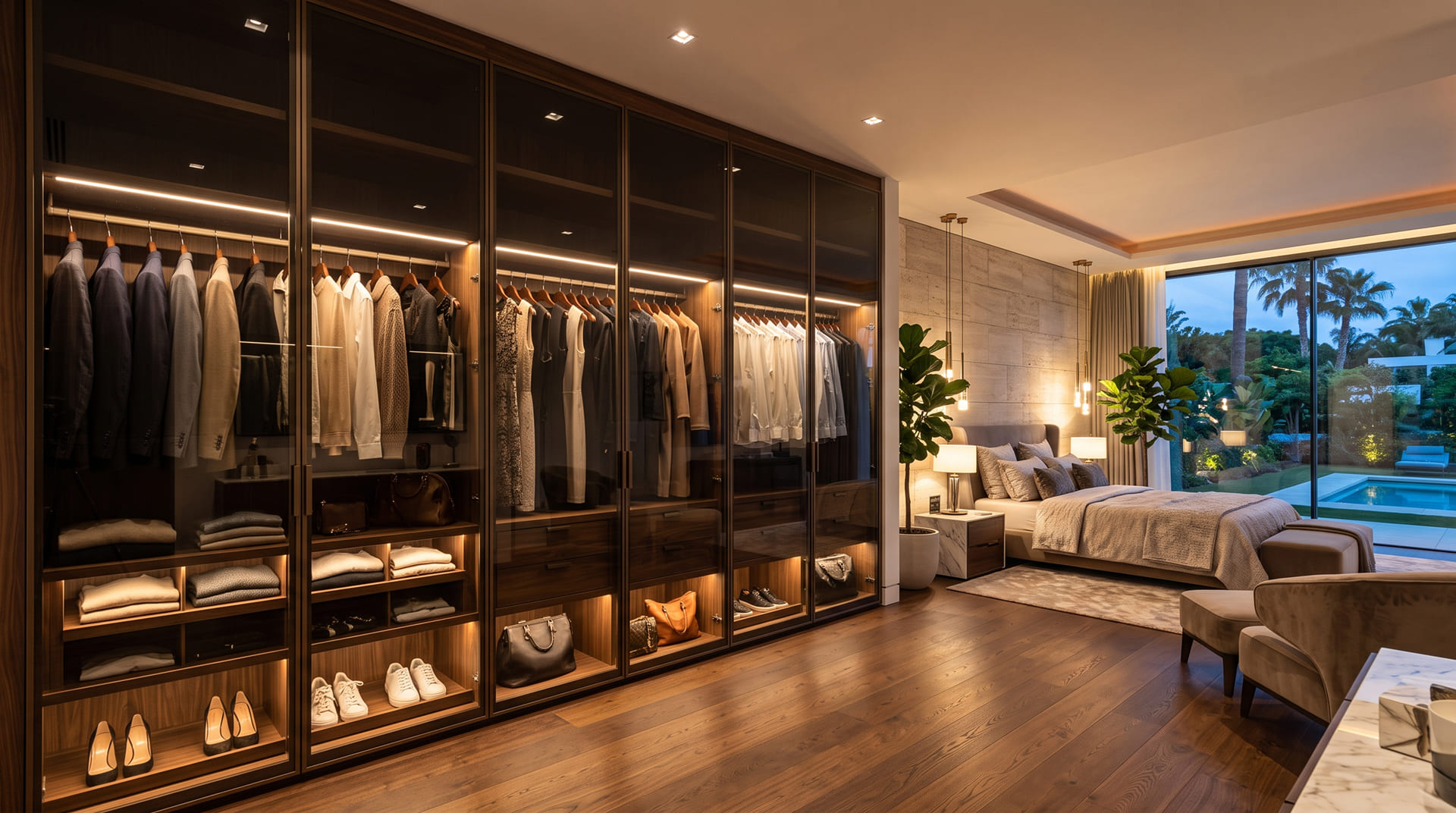
Integrated vertical lighting instantly transforms a custom wardrobe into an executive dressing suite.
- Side-Washing Light Distribution: Traditional wardrobes rely on single overhead downlights that cast harsh downward shadows. Conversely, vertical Chip-on-Board (COB) LED strips—recessed inside anodized aluminum channels along vertical side stiles—wash light evenly across hanging garments.
- Calibrated Color Spectrum (3000K Warm White): We specify 3000K warm white LEDs with a High Color Rendering Index (CRI ≥ 90). This keeps clothing colors accurate while washing the bedroom in a resort-style evening glow.
- Automated Motion Activation: Magnetic reed sensors built into cabinet frames trigger interior lighting automatically when doors glide open.
3. Light-Colored Interior Carcasses: Reflective Visibility
A common oversight in wardrobe manufacturing is finishing interior carcasses in dark wood tones to match dark exterior facades. Dark cabinet interiors absorb room light, making it difficult to differentiate dark garments.
- Reflective Light Bounce: Finishing internal carcasses in soft linen-textured HPL, warm beige, or light greige reflects artificial light across internal bays. Consequently, every stored item remains fully visible.
- Hygienic Cleanliness: Light-colored melamine and laminate surfaces highlight dust, simplifying maintenance while creating a modern ambiance similar to luxury boutique displays.
4. Hidden Handles & Recessed Profiles: Architectural Serenity
Large, protruding metal handles disrupt door surfaces, creating visual clutter across expansive wardrobe runs. Clean lines remain paramount in modern tropical and contemporary villa interiors.
- CNC-Milled Finger Grooves (J-Pulls): Continuous handle channels are milled directly into panel edges using multi-axis CNC routers, allowing ergonomic gripping without protruding metal hardware.
- Anodized Aluminum Gola Channels: Recessed C-shaped metal channels installed behind door edges provide a tactile grip line while adding a subtle metallic shadow accent.
- Push-to-Open Latches: Mechanical magnetic latches allow door faces to remain completely flat, opening softly with a light touch.
5. Continuous Grain Matching & Bookmatching: Artisanal Mastery
Continuous wood grain matching separates basic factory production from high-end custom joinery.
- Random Slicing (Standard Joinery): In mass-produced wardrobes, veneer sheets are applied without regard for grain direction, resulting in clashing timber patterns across adjacent doors.
- Bookmatching & Sequence Matching (Bali Interio Standard): Master joiners slice veneer leaves sequentially from the same timber flitch and arrange them like open book pages. The natural wood grain cascades continuously across multiple doors, creating the illusion that the entire wardrobe was carved from a single timber trunk.
5 Common Joinery Mistakes That Cheapen Wardrobe Design
When auditing problematic wardrobe installations during villa renovations, senior inspectors frequently identify five recurring errors:
- Inconsistent Door Reveal Margins: Door gaps varying from 1 mm at the top to 6 mm at the bottom due to uncalibrated hinges.
- Clashing Wood Grain Orientation: Horizontal wood grain on one door paired directly next to vertical grain on an adjacent drawer face.
- Overly Dark Interior Finishes: Dark espresso interiors that absorb ambient light and conceal garments in shadow.
- Harsh Overhead Ceiling Shadows: Relying entirely on single bedroom downlights, casting deep body shadows into open wardrobes.
- Protruding Hardware: Oversized plastic or shiny metal handles that clutter door planes and catch on clothing.
Correcting these five detailing errors yields a greater visual upgrade than simply purchasing more expensive raw materials.
Crafted to Perfection: Custom Manufacturing at Bali Interio
At Bali Interio, we recognize that true luxury joinery is achieved through rigorous engineering, state-of-the-art machinery, and disciplined Quality Control (QC).
Our Denpasar manufacturing facility transforms raw materials into custom wardrobe masterpieces through an integrated workflow:
- 3D Laser Site Surveying: On-site laser scans measure wall angles, floor levels, and ceiling heights down to millimeter accuracy.
- Automated G-Code Machining: Panels are sized on computer-guided Selco beam saws and multi-axis CNC routers (±0.1 mm tolerance), milling precise shadow gap channels and Gola profile slots.
- Flitch Sequence Matching: Master joiners hand-select veneer sheets, matching timber grain sequences prior to hydraulic pressing.
- Watertight PUR Edge Banding: All panel perimeters are machine-sealed using Polyurethane (PUR) hot-melt adhesive, forming a waterproof seal against tropical humidity.
- Factory Mock-Up & Pre-Assembly: Assembled wardrobes undergo complete factory dry assembly, verifying door reveal uniformity, LED sensor circuits, and soft-closing hardware before site delivery.
When planning a custom wardrobe bali project, look beyond basic material names. Ask how shadow gaps will be calibrated, how grain sequences will be matched, how vertical LEDs will be recessed, and how interior carcasses will reflect light. Contact the Bali Interio design engineering team today to schedule an initial spatial consultation and request a custom joinery proposal.